
A House of Our Own
May 27, 2026
At 549 Columbus, a Boston design-build firm became its own most demanding client and inherited a foundation problem from 1875.
Boston’s South End is a Victorian neighborhood of bowfront brownstones, brick rowhouses, and tree-lined avenues — planned and built between the 1840s and the 1880s on what had been tidal marsh. At 549 Columbus Avenue, inside a seven-unit condominium building completed in 1875, Longfellow Design Build has opened its new Boston headquarters and showroom in what was once a South End bookstore. The renovation turned on a piece of nineteenth-century engineering most owners of these buildings will never see.
The neighborhood sits on ground that did not exist two centuries ago. In the mid-nineteenth century, the marshes between Beacon Hill and Roxbury were filled with gravel brought in by rail from Needham, then platted into a grid of avenues and squares. The brick masonry buildings that rose on those streets were three to five stories of load-bearing walls carrying clear-span wood floor joists, set on a particular kind of nineteenth-century foundation.
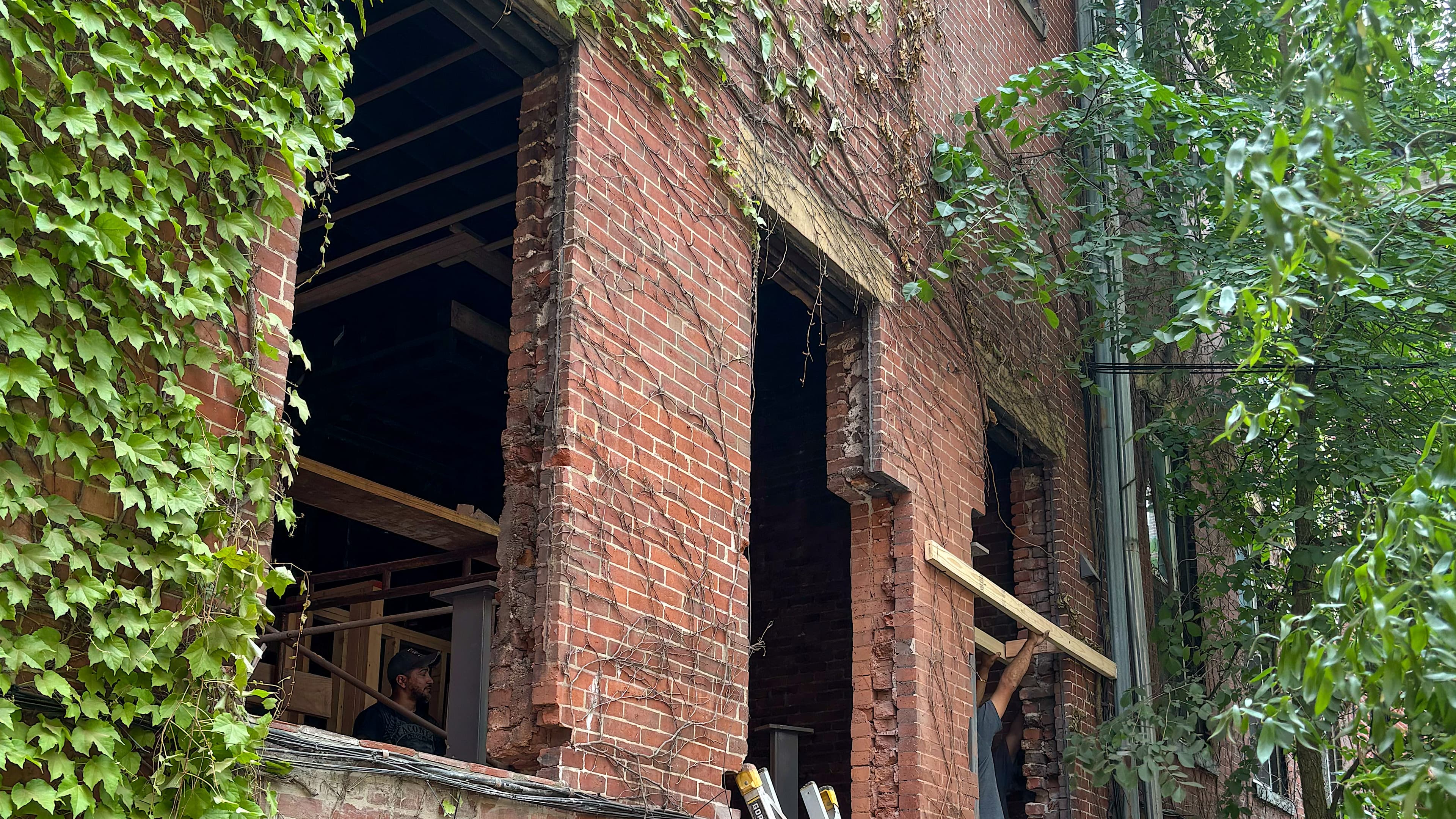
Longfellow Design Build crew demolishing the 1899 Columbus Avenue facade during the South End headquarters renovation.
Because steel piles were not yet available at scale, the foundations were timber: piles driven through the fill and the blue clay below, capped with squared granite blocks, with a brick bearing wall sitting on the granite. The piles sit below the groundwater table, sealed from air, where they have held the neighborhood up for more than a century and a half.
549 Columbus stands on the same wood-pile system as its neighbors. The bookstore that occupied Unit C, the building’s ground-and-lower-level commercial space, closed during the pandemic, and Longfellow’s brief for the conversion was a three-level studio: a storefront with presence on Columbus, a usable loft above, and a finished lower level for collaborative work, with a kitchenette, lounge, and mechanical systems.
The Firm as the Client
The architecture, the structural engineering, and the construction at 549 Columbus all fell to Longfellow. So did the brief. The firm took the building on as both client and design-build team — an integration that defines how Longfellow works on its residential commissions, and that here folded the owner role inside the same studio. The decisions made on the building were made by the people who would occupy it.
That arrangement shaped the work. There were no submittals to translate between firms, no design review with an outside client, no friction between architectural intent and contractor preference. The teams that drew the building also priced it, engineered it, scheduled it, and finished it.
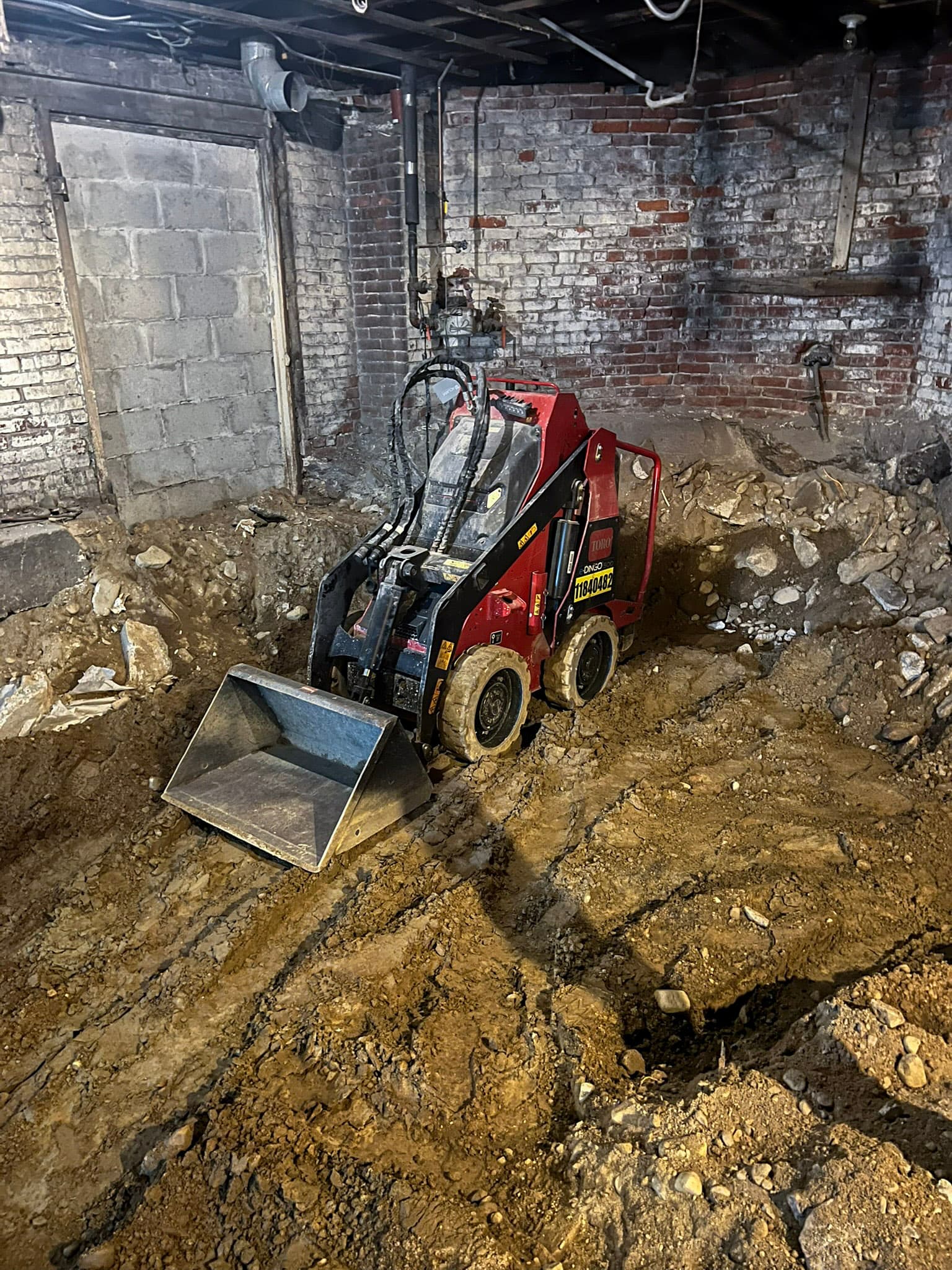
basement dig out image
The Foundation Comes First
The first move at 549 Columbus was structural. The lower-level floor had to come down to give the collaborative workspace, kitchenette, lounge, and bath the headroom an office requires. Lowering a basement slab anywhere is delicate. Lowering one inside a 151-year-old building on wood pilings is a different kind of delicate. The groundwater around the piles cannot drop, and it cannot find its way into the finished space. The granite caps had to be preserved during excavation: ivy roots had worked into them and turned the original mortar to dust. An interior partition wall, set on boulders the size of a couch, had to come out while the residences above stayed supported.
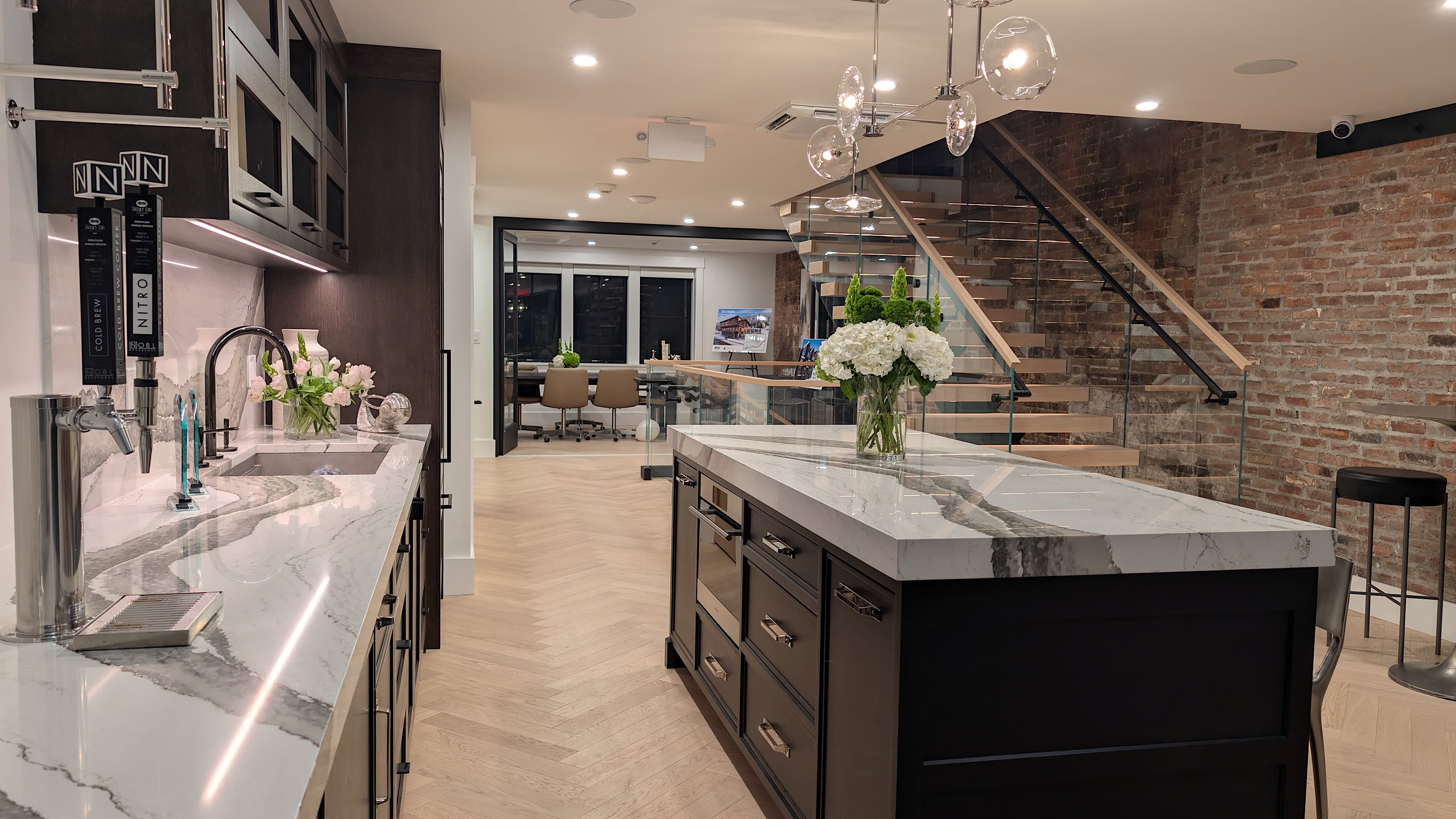
Longfellow’s design team built the lower-level program around the existing structure. A perimeter encasement holds the original granite blocks in place, with built-in bike storage and lockers running above. A kitchenette and full bath round out the downstairs studio, the finished ceiling coming in at roughly nine feet. The studio reads as a floor of a working office, a big improvement over the damp, unfinished mechanical space it had been.
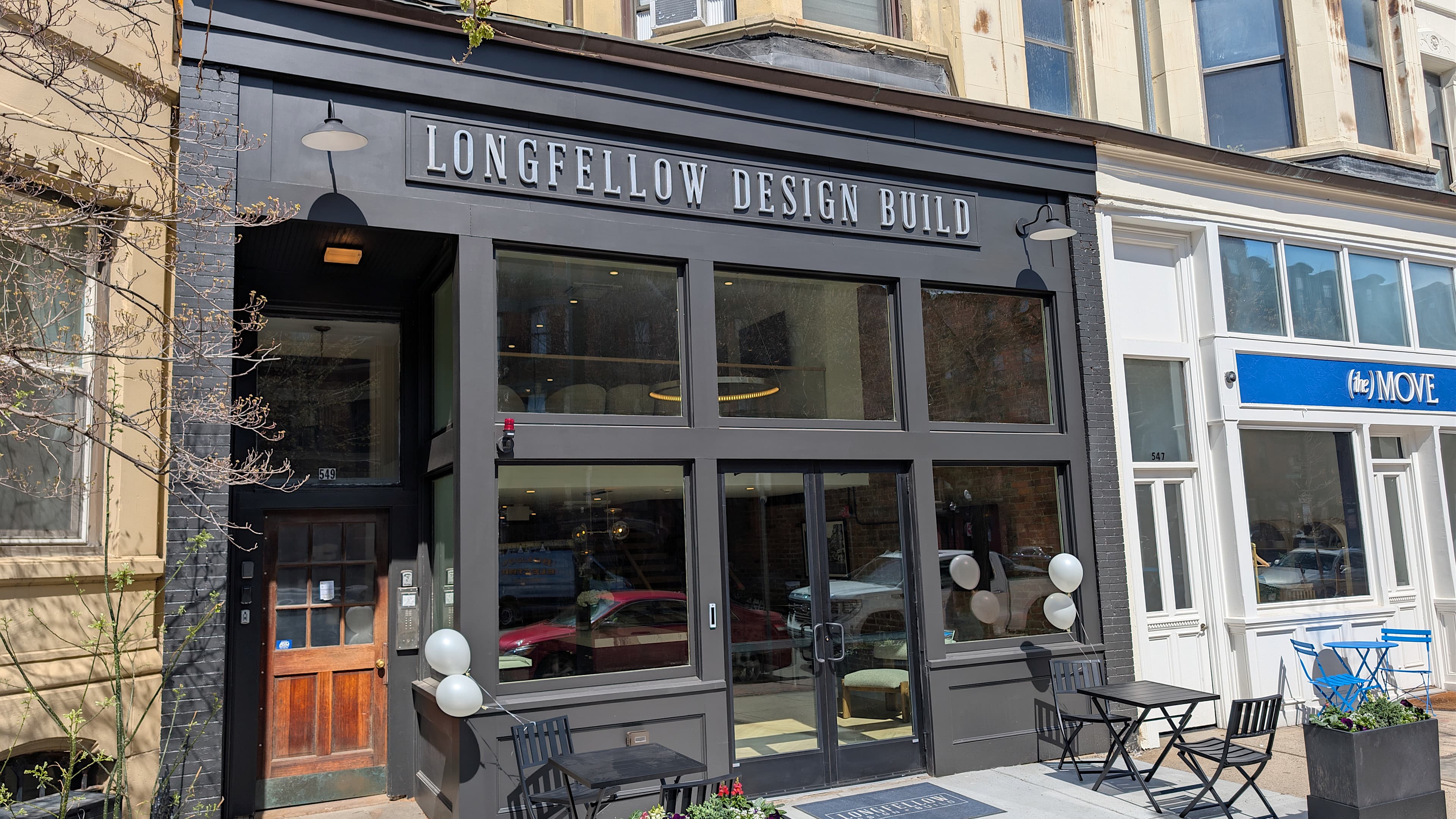
Longfellow Design Build's completed Boston showroom and headquarters at 549 Columbus Avenue, South End.
The Storefront and the Loft
The street-level façade was rebuilt as the studio’s public face on Columbus Avenue. Larger glazing, a cleaner window line, and a new entry replaced the bookstore frontage and let the studio’s interior read through to the street. Shaker-trimmed wall panels and wooden window frames were installed under the South End Landmark District Commission’s Standards and Criteria, preserving the Victorian details that give the neighborhood its character.
Above the main level, the loft was rebuilt with approval from the Boston Zoning Board of Appeals: a second-level workspace with a new stair opening that ties into the unit’s two means of egress. The double egress supports a planned forty-nine-person occupancy. The opening is filled by a floating steel monorail stair, finished with oak treads, black hardware, and glass railings that let daylight reach the full height of the space.
Systems
The fire alarm for the entire building was replaced with a current addressable system that reports to Boston Fire. Two air handlers tuck against the rear wall of the lower level, keeping mechanical equipment out of the workspace volume. New operable windows restore natural ventilation and daylight at the front and back of the unit and bring the envelope into line with Massachusetts energy code. The first floor is accessible at street grade; the loft and lower level remain stair-served, consistent with the building’s original condition.
The Studio
Longfellow has been working in the South End since 2023. The headquarters at 549 Columbus deepens that presence and gives the firm something a website cannot: a place clients can walk into and see the cabinetry, finish samples, lighting, and detail work that go into a Longfellow home. The studio also serves as the Boston sales office for South Peak Resort, Longfellow’s New Hampshire mountain community on Loon Mountain, and as a meeting space for clients across the practice in Massachusetts, New Hampshire, Rhode Island, and Florida.
At a glance, the choice of building reads as a deepening of place. The work itself is more direct. The architecture, the structural engineering, and the construction were Longfellow’s. So was the brief. The studio that resulted is the firm’s home.
Project Team
- Client: Longfellow Design Build
- Architect: Longfellow Design Build Architecture
- Structural Engineer: Longfellow Design Build Engineering
- Builder: Longfellow Design Build Construction